Rental Panel Income: A Realistic Profit Model and Your First 90 Days
A rental panel earns the gap between supplier cost and your price, times volume. Here is the formula, a worked example and what the first three months usually involve.
Key takeaways
- Monthly profit = orders x margin per order, minus platform cost, payment fees and marketing.
- Margin and volume matter far more than the platform fee, which is why a flat low fee helps.
- Break-even orders = monthly fixed costs divided by profit per order.
- The numbers below are examples to show the maths, not income promises.
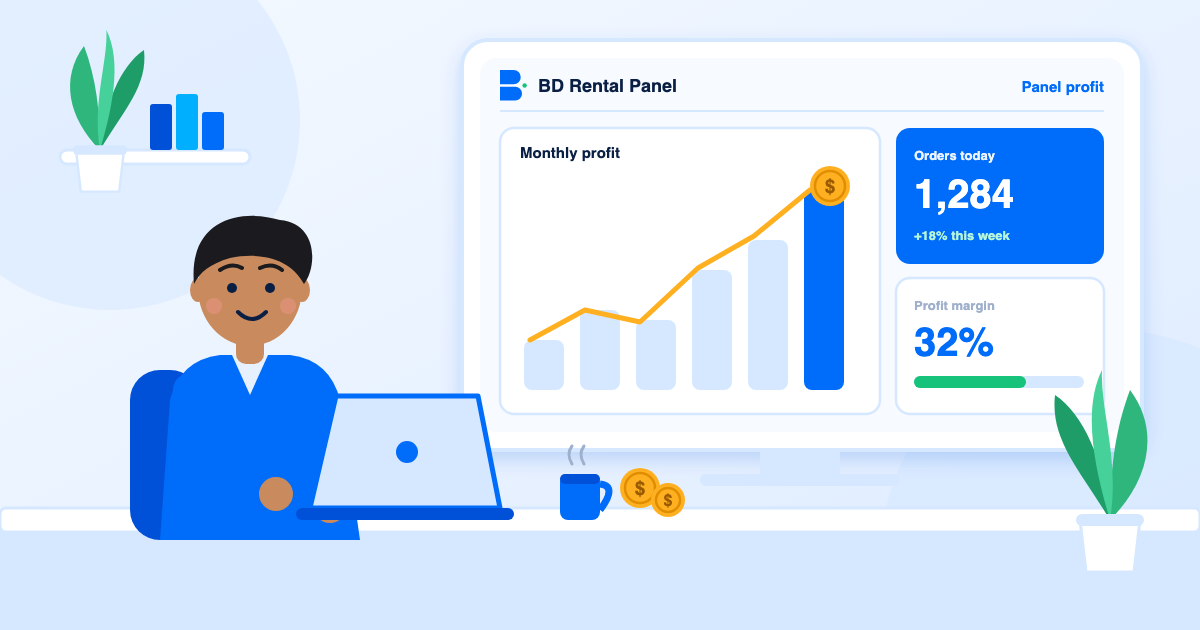
Everyone asks how much a rental panel can make. The honest answer is that it is a tool, not a salary. It earns the difference between what you pay suppliers and what customers pay you, multiplied by how many orders you win. Below is a simple model you can fill with your own numbers. All figures are illustrative.
The formula
Monthly profit = (orders x average margin per order) minus platform cost, payment fees, marketing and tools.
| Item | Example |
|---|---|
| Orders per month | 1,500 |
| Average order value | $4.00 |
| Revenue | $6,000 |
| Supplier cost (75%) | $4,500 |
| Gross margin | $1,500 |
| Payment fees (3%) | $180 |
| Platform (Premium Plan) | $11.49 |
| Marketing | $300 |
| Net profit | about $1,008 |
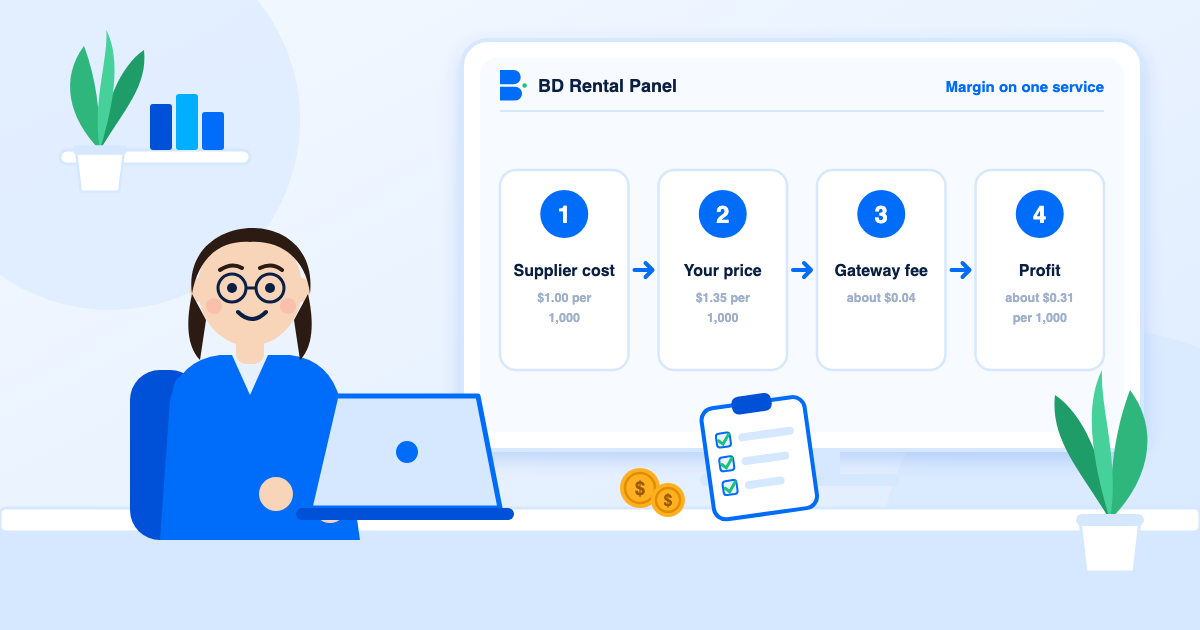
Lower the margin to 15% and net profit falls to about $409. Keep 25% but sell only 600 orders and it is about $216. The platform fee barely moves the answer, which is why a flat, low platform cost is helpful and a share of every order is not. See profit margins explained.
Pricing rules that protect margin
- Know each service's supplier cost and keep it synced.
- Add a margin, often 20% to 40% on standard services and more on premium ones.
- Build in the gateway fee or add it to that payment method.
- Look at similar panels, but compete on trust and refill, not on being cheapest.
- Apply changes with percentage editing so a whole category updates at once.
Break-even
Divide fixed monthly costs by profit per order. If fixed costs are $11.49 for the platform plus $100 of marketing and you earn $0.60 profit per order after supplier cost and fees, you need about 186 orders a month. Every order beyond that is profit. With unlimited orders on every plan, there is no tier to cross as you grow.
Your first 90 days
- Days 1 to 7: launch with a small, tested catalogue and two payment methods.
- Days 8 to 30: win your first 20 to 50 customers through people you know and small tests.
- Days 31 to 60: fix the questions you get most, publish refill rules and your first posts.
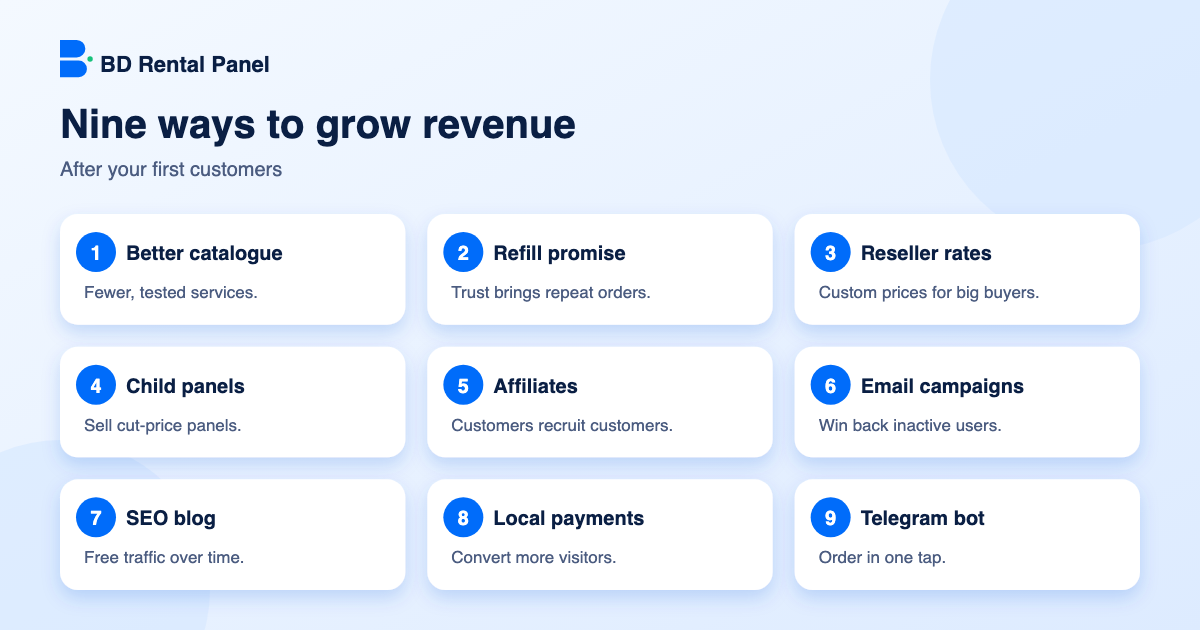
- Days 61 to 90: add reseller rates, an email campaign and an affiliate programme.
Risks to plan for
- Supplier quality. Bad delivery means refunds. Test before listing.
- Price changes. Unsynced prices can turn a service into a loss.
- Chargebacks and fraud. Use verified gateways and limits for new accounts.
- Platform rules. Social networks change policies; spread your services.
- Cash flow. Supplier balances must be funded. Start small.
Pricing psychology that helps conversion
Customers judge a price list quickly. Group services by outcome, such as followers, likes and views, show delivery time next to the price, and put your most reliable service first in each category. Offer one recommended service per category. Dozens of near-identical services at slightly different prices make people hesitate, and hesitation costs orders.
Keeping margin safe
Supplier prices move, sometimes daily. If your panel does not sync, a rise silently turns a profitable service into a loss. Use scheduled sync, look at a profit report each week and treat a service with negative or very thin margin as a bug to fix the same day. See pricing strategy for rules of thumb.
Where to put profit
A simple rule many small panels follow is about a third of profit back into marketing, a third into supplier balances for cash flow and a third kept. Adjust as revenue grows, and keep a separate reserve for refunds so one bad week does not become a crisis.
What to measure in the first month
Those five numbers tell you where to spend your next hour: acquisition, conversion, supply, support or pricing.
- Signups per day and the share who add funds.
- Average order value.
- Failed orders per hundred and the reasons.
- Tickets per hundred orders and the most common questions.
- Gross margin after supplier cost and gateway fees.
Scaling later
Once the basics are steady, how to scale an SMM panel business covers reseller rates, child panels and automation.
Three versions of month three (illustrative)
These columns show how sensitive the result is to volume and margin. They are examples to practise the arithmetic, not forecasts, and many new panels earn less in the first quarter while they learn.
| Cautious | Steady | Strong | |
|---|---|---|---|
| Orders a month | 400 | 1,200 | 3,000 |
| Average order | $3.50 | $4.00 | $4.50 |
| Margin on revenue | 20% | 25% | 28% |
| Gross margin | $280 | $1,200 | $3,780 |
| Fees, platform and marketing | $150 | $450 | $900 |
| Net | $130 | $750 | $2,880 |
What slows a new panel down
- Too many untested services.
- No clear refill and refund rules, so support eats the week.
- A single weak supplier.
- No plan for finding customers beyond friends.
- Changing prices constantly instead of fixing quality.
Frequently asked questions
It depends on volume, margin and marketing. The formula is orders x margin per order minus costs. The examples here are illustrative, not promises.
Many panels aim for roughly 20% to 40% on standard services, adjusted for quality and competition.
No. There is no revenue share and no per-order fee.
Divide fixed monthly costs by profit per order. With $111 fixed costs and $0.60 profit per order, about 186 orders.
It varies. Break-even depends on fixed costs and profit per order; the formula above lets you calculate your own point.
Launch your own rental panel
Hosting, SSL and updates included, live on your domain in minutes.